You have picked a name for your website, say boulangerie-lyon.fr. You search for it at three companies and get three prices: €1.20, €5.99 and €7.20 incl. VAT. The domain is the same, and so is the address your customers will see. So does it matter where you buy it?
In short: it does, but not in the first year. A .fr domain is the same everywhere. What differs between French domain registrars is the renewal price, the transfer terms and how easy it is to manage the domain yourself. Below are six things to check before you pay, followed by a comparison of four registrars well known to French businesses, based on their own websites.
How to choose the name and the extension is covered in How to choose the right business domain in France. This article is only about where to register it.
Who runs .fr and who can register one
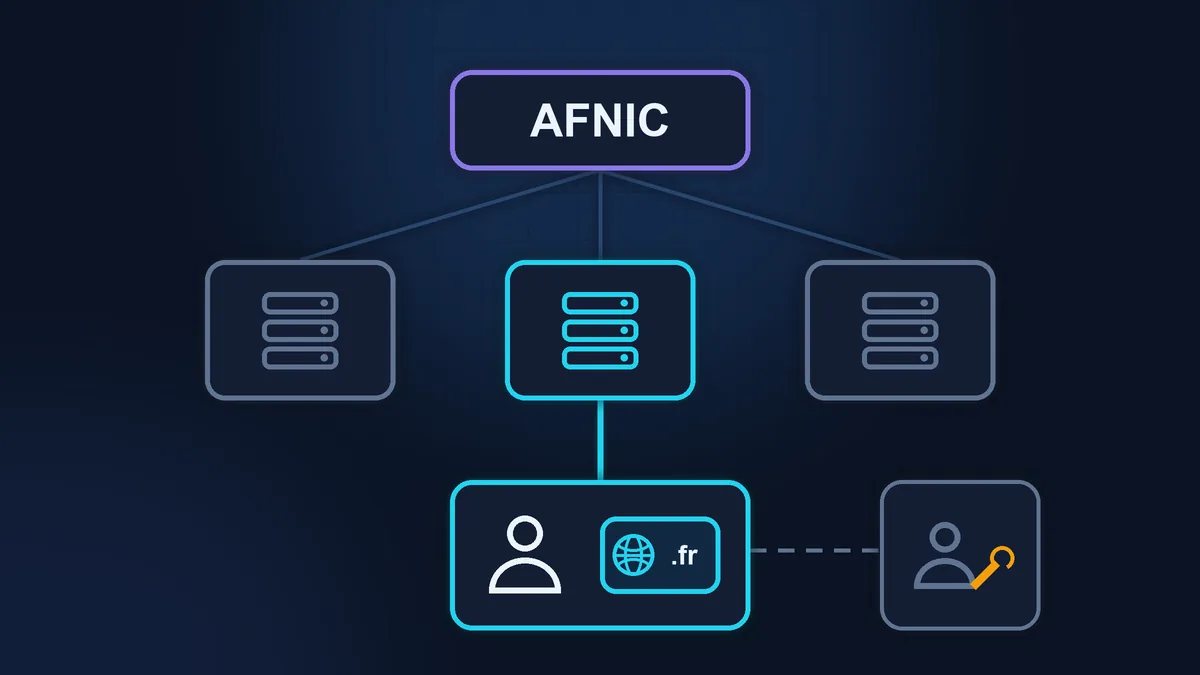
The .fr extension is run by AFNIC, a French non-profit association that keeps the registry of every .fr address. AFNIC does not sell domains directly to individuals or businesses. That is done by registrars (bureaux d’enregistrement in French): companies accredited by AFNIC, through which you register, renew and transfer your domain. AFNIC’s directory of accredited registrars lists more than 300 of them, and you can check any company there (registrar directory).
Who can register a .fr is set out in AFNIC’s rules (the naming policy, or charte de nommage, of 6 July 2026, article 5.1):
- an individual who lives in an EU country, Iceland, Liechtenstein, Norway or Switzerland;
- a company whose registered office or principal place of business is in one of those countries.
The rules say nothing about citizenship: what matters is where you live. If you live in France on a residence permit, you can register a .fr. The owner and the administrative contact must be reachable: a working phone number and email address, and accurate details that you update when they change. I am not a lawyer; the primary source is here: AFNIC charte de nommage (PDF, in French).
What to compare: six points

1. Renewal price
The first year is often on offer, but you will pay every year. Look for the “renouvellement” (renewal) line in the price list or in the basket before you pay. A .fr can be paid for up front for 1 to 10 years.

2. Who the owner is
In the domain data, the owner is called the titulaire (holder). It should be you or your company, not the web agency and not an employee. The agency can be listed as the administrative contact (if it is based in the EU): under AFNIC’s rules, that contact has no rights over the domain.

3. Your own access to the dashboard and DNS
DNS (the system that connects your address to your website and email) is set up in the registrar’s dashboard. The account should be registered to your own email address, with two-factor authentication turned on. If the registrar allows it, give your webmaster separate access rather than your password.

4. Lock and transfer
The lock (AFNIC calls it protection du nom de domaine, or FR Lock) prevents any changes to the domain unless you confirm them. To move to another registrar, you need an auth-info code: a transfer password issued by your current registrar in the dashboard or on request from support. Check where to get it and what a transfer costs.

5. WHOIS and your data
WHOIS is the public directory of domain owners. If the domain is registered to an individual, AFNIC does not show the name, address or phone number there by default. If it is registered to a company, its details are visible to everyone. A micro-entrepreneur (auto-entrepreneur, France’s simplified sole-trader status) who registered the domain in their own name is usually treated as an individual. An individual does not need to pay for “WHOIS privacy” on a .fr.

6. Email and hosting bundles
Many registrars sell the domain together with mailboxes and hosting. That is convenient, but then your website, email and address all depend on one company. Decide in advance whether you need a bundle, rather than taking it just for the first-year freebie.
Four French domain registrars compared
This is not a ranking. These are four companies well known in France, all accredited by AFNIC. Prices were taken from their websites in October 2026, excluding VAT (HT in French), for a single .fr domain. Offers change often, so check the price in the basket before you pay.
| Registrar | First year, excl. VAT | Renewal, excl. VAT |
|---|---|---|
| OVHcloud | €4.99 | €7.79 |
| LWS | €4.99 | €8.99 |
| Gandi | €6.00 | €23.98 |
| IONOS | €1 | not stated |
What the websites show besides the price (all four pages are in French):
- OVHcloud (.fr page): transferring a domain to OVHcloud costs €4.59 excl. VAT and takes 4 to 6 days, changing the owner is free, and 100 MB of hosting comes with the domain. If you forget to renew, there is a 30-day grace period after expiry. If the domain has already been deleted, you can still restore it for another 30 days for €49.99 excl. VAT.
- LWS (.fr page): the price includes two 1 GB mailboxes and 1 GB of hosting (no PHP, enough for a couple of simple pages; it cannot run WordPress). Changing the owner costs €29 excl. VAT, restoring a domain €19.99 excl. VAT. The first-year price is an offer; the standard price applies from the second year.
- Gandi (.fr page): prices on the site include VAT, €7.20 and €28.78; the table shows them without it. If you renew for 2-9 years at once, there is currently an offer: €25.90 per year incl. VAT (about €21.58 excl. VAT). With this offer, ten years at Gandi cost about €200 excl. VAT instead of €222. Also included: an SSL certificate for the first year and DNSSEC, which protects your DNS against spoofing. There are no mailboxes, only email forwarding.
- IONOS (.fr page): the first year is on offer at €1 excl. VAT, and the standard price on the page is €11 excl. VAT. I could not find the renewal line there, so check it in the basket. If you order hosting from them with a commitment of at least 12 months, the .fr is free for the first year. With their website builder, the domain is free for as long as you use the builder, but if you leave it, you will have to pay for the domain.
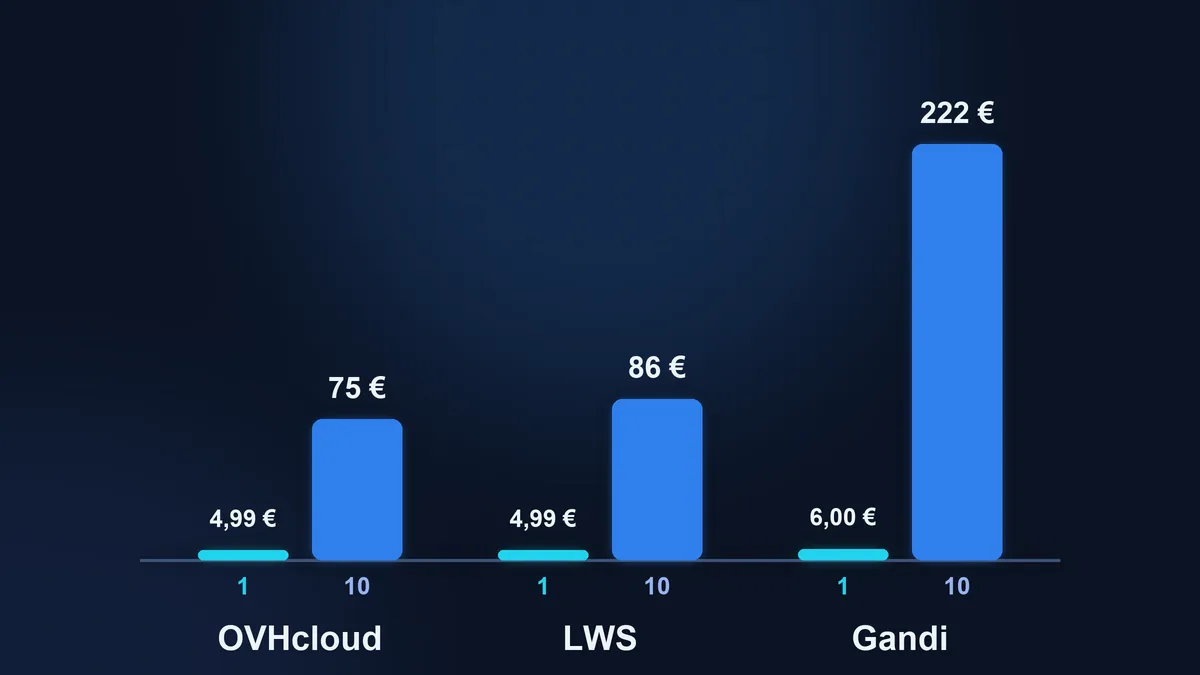
An expensive renewal does not mean a “bad registrar”: the price may include DNS, a certificate and support that another registrar charges for separately. But do the maths over several years, not on the first invoice.
If you already have a domain: how to check who owns it
Open WHOIS on the AFNIC website and enter your domain name. You will see the registrar and the expiry date. If the domain is registered to a company, its name will be shown too. If it is registered to an individual, the owner’s details will not be there, and you can only find out from the account at the registrar.
If a web agency registered the domain and the account is not yours, ask them to show you who is listed as the owner (titulaire). If it is the agency rather than you, arrange a change of owner now, while you are still on good terms. At OVHcloud and Gandi this is free; at LWS it costs €29 excl. VAT.
Transferring to another registrar
If the terms no longer suit you, you can transfer the domain. It usually works like this:
- At your current registrar, remove the transfer lock if it is on and get the auth-info code. It is usually in the dashboard under the domain; if it is not there, ask support.
- At the new registrar, choose transfer (transfert on French sites) and enter the code.
- There is usually a fee for a transfer, and it generally extends your registration. The owner does not change; AFNIC’s rules say so explicitly.
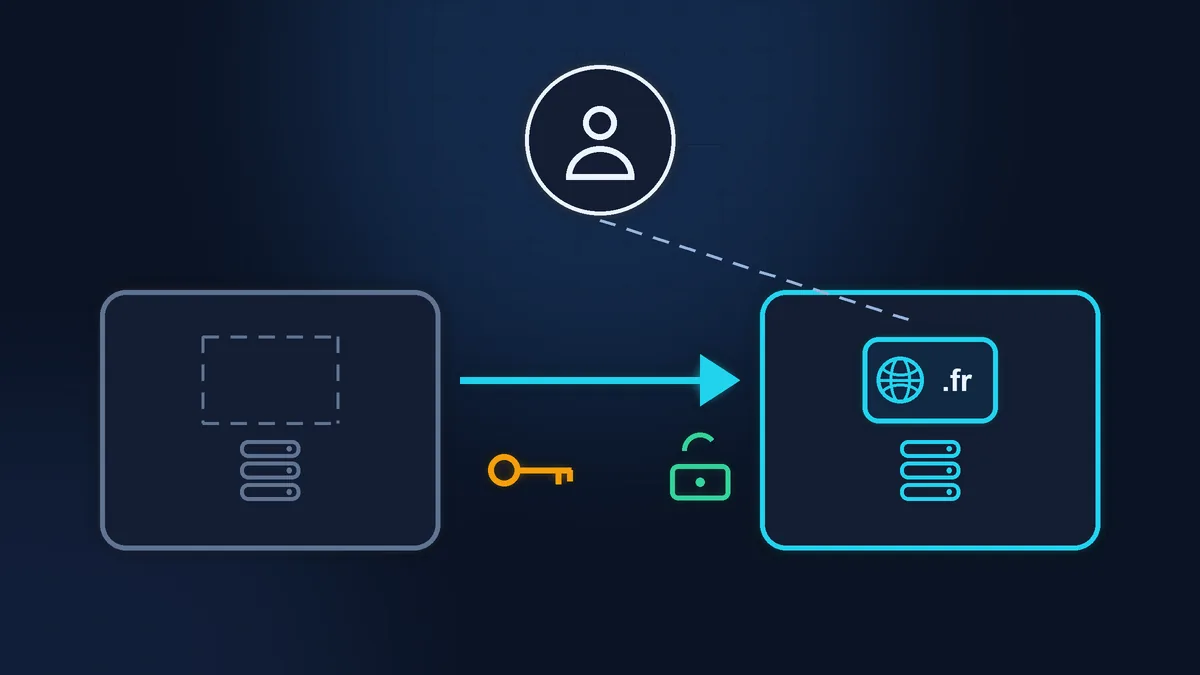
The main risk in a transfer is not the domain itself but the DNS. If the old registrar hosts the DNS records for your email and website and they are not recreated at the new one, email can stop arriving. Before the transfer, save a copy of all DNS records: a screenshot or an export from the dashboard.
Email and website in one place or separately

Everything with one provider
- one account and one invoice
- DNS is often set up automatically
- suits a small brochure website and a few mailboxes
- but if something goes wrong with the account, both the website and email go down

Domain kept separate
- you can change hosting without touching the domain
- email can stay with a specialist provider
- handy if a contractor builds the site on their own hosting
- but you will have to set up DNS by hand
For a small business, both options are fine. What matters is that the account holding the domain is yours. If email sent from your domain lands in spam or does not arrive, that is a question of DNS records for email: website forms and email setup.
Checklist before you pay
- The registrar is listed in the AFNIC directory.
- You know the renewal price, not just the first-year price.
- You or your company are listed as the owner (titulaire).
- The account uses an email address you will not lose, and two-factor authentication is on.
- Auto-renewal is on, the card is valid, and the expiry date is in your calendar.
- You know where to get the auth-info code and what a transfer costs.
- You know whether you need a bundle with email and hosting or just the domain.
When to start with a plan
With this checklist, a beginner can register a new .fr in an evening. It gets harder when the domain already runs a website and email: moving between registrars, changing hosting at the same time as the domain, or a domain still held by a former agency that no longer responds. In these cases, a single missed DNS record can leave you without customer emails for several days. In that situation, it is better to make a plan first.
If your time is worth more
You can do everything above yourself: compare renewal prices, put the domain in your name and turn on the protection. If you would rather not deal with it, in a starter consultation we will go through your case in an hour: where to register, whether you need a bundle with email, how to get the domain back from a contractor and what a transfer requires. It starts from €49 excl. VAT, and if you order work within 7 days, that amount is deducted from the cost of the work.
Rather not deal with it yourself?
Describe the task in a few words. I'll reply within one working day with what needs doing, the price and the timing.
Latest posts