A domain often gets bought at the last minute: the site is almost ready, an address needs choosing in a hurry, someone clicks the payment button, and the matter seems settled. In practice, a domain is not a minor technical purchase; it is one of the business’s key assets. The website, e-mail, Google Business Profile, advertising, business cards, QR codes, invoices, contracts and customer trust all run through it.
If a domain is set up incorrectly, the problem can surface a year later, when a staff member leaves, during a dispute with a provider, or at renewal time. The owner then discovers something unpleasant: the site might be theirs, the copy might be theirs, the logo might be theirs, but the address on the internet is effectively controlled by someone else.

Why a domain matters more than it seems
A domain is not just a website’s address. It is the foundation of the business’s digital identity. If the domain stops responding, the customer cannot open the site. If the DNS is set up wrongly, e-mail can stop working. If the domain is lost, old links, adverts, e-mail addresses, QR codes, e-mail signatures and every piece of material carrying that address can all stop working at once.
For a local business in France, a domain is often tied up with trust. A .fr address tends to look natural for the French market, especially with a local audience. A .com can also be a sound choice if the brand is international, already established, or planning to expand beyond France. Sometimes it makes sense to register both: one as the main address, the other redirected to the site.
But the extension is not the only question. It matters far more to know who is listed as the domain’s owner, where it is registered, who receives the renewal e-mails, whether auto-renewal is switched on, who has access to the DNS, and what happens if the current web professional, staff member or agency disappears.
Three roles: owner, registrar, web professional
To avoid confusion, it helps to separate the roles clearly.
The domain owner is the company, the entrepreneur, or the person the domain should genuinely belong to, given the nature of the business. In registration data this is often called the “registrant”. In everyday language people say “owner”, even though technically a domain is never bought outright; it is registered for a period and renewed.
The registrar is the service through which the domain is registered and renewed. For example OVHcloud, Gandi, IONOS, LWS, Infomaniak, Namecheap, Cloudflare Registrar, GoDaddy and others. For .fr, Afnic maintains a list of accredited registrars authorised to handle registration, renewal, transfer, ownership changes and deletion of domains.
The web professional is the person who can help: choosing a domain, configuring DNS, connecting the site, e-mail, SSL, SPF, DKIM, DMARC, redirects and monitoring. But a web professional should not end up owning the client’s domain unless the client clearly understands and accepts that risk.

Owner
The company or sole trader. Owner’s contact details, billing, a backup e-mail address.

Registrar
Where the domain was bought: OVHcloud, Gandi, IONOS, LWS, Namecheap and others.

Web professional
Technical help: DNS, the site, e-mail, renewal, monitoring.
If the domain matters to the business, the rule is simple: the registrar account should stay under the business owner’s control. A web professional can have technical access, delegated access, or task-specific access, but never the sole key to the domain.
How to choose a domain name
A good domain is easy to say, write and remember. That matters especially for restaurants, salons, tradespeople and local services, whose address often gets read out over the phone, typed into a messaging app, or printed on a business card.
Check a domain against a few simple criteria:
- the name is short and easy to read;
- no complicated hyphens, if they can be avoided;
- no unusual transliteration that people would find confusing;
- no digits, unless they are genuinely part of the brand;
- the extension makes sense to your audience:
.fr,.com, sometimes.restaurant,.shop,.paris, or another suited to the purpose; - the name does not resemble someone else’s brand or a registered trademark;
- the domain looks right inside an e-mail address;
- it can be said out loud without needing to explain “there’s a hyphen there, a double letter there, it’s not spelled the way it sounds”.
For a business in France, .fr is often the logical default. According to Gandi, .fr is open to individuals in the European Union and to companies in Europe, as well as in Switzerland, Norway, Iceland and Liechtenstein. That does not mean .fr is always better than .com, but for a local business it reads clearly as a French address.
Where to register a domain
What follows is neither a ranking nor a final recommendation. It is a list of registrars worth treating as a starting point.
France and Europe:
- OVHcloud, a French company and a popular choice for domains, hosting and servers;
- Gandi, a well-known registrar with a long track record in the French market;
- IONOS, a large European provider of domains, websites and hosting;
- LWS, a French registrar and hosting provider;
- Infomaniak, a Swiss provider serving the European market.
International options:
- Namecheap, a popular international registrar for
.comand many other extensions; - Cloudflare Registrar, worth considering for anyone already using Cloudflare’s DNS, CDN or protection services;
- GoDaddy, a large international registrar with a wide range of related services;
- Porkbun, a straightforward international registrar often chosen for its clear registration process;
- Squarespace Domains, an option for anyone using the Squarespace ecosystem or coming over from Google Domains.
What to look at when choosing:
- the registration price and the renewal price, not just the first-year promotion;
- whether the registrar supports
.fr, if that is what you need; - whether the DNS management panel is convenient to use;
- whether two-factor authentication is available;
- whether separate access can be granted to a web professional;
- whether DNSSEC is supported;
- how domain transfers work;
- how quickly support responds;
- whether it is clear where to turn on auto-renewal;
- whether unnecessary add-on services get pushed on customers who do not understand them.
Common mistakes
The most expensive mistake is registering the domain under someone other than the business owner. This usually happens with no bad intent at all. A web professional buys the domain faster through their own account, a staff member sets up an account with their personal e-mail, an agency registers everything centrally, and the client never asks questions. As long as everything works, the problem stays invisible.
The problems start later:
- the web professional stops responding;
- the staff member has left the company;
- the renewal e-mail address no longer exists;
- the card on file has expired;
- the client has no idea where the domain was bought;
- the DNS is locked inside an account that is not theirs;
- moving the site is blocked for lack of access;
- the domain has expired, and the renewal e-mails were never going to the owner.
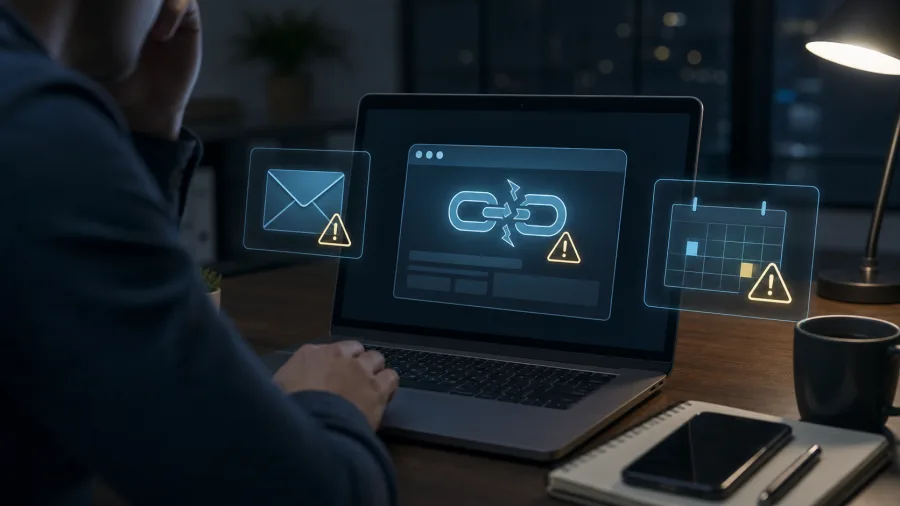
Namecheap warns plainly: if a domain expires, the website and e-mail stop working, and the owner loses the ability to make changes to the domain until it is restored. Different extensions and registrars have their own recovery windows, but none of them should be relied on as a genuine safety net. If a domain lapses further and becomes available for registration again, anyone can buy it.
Real examples
First example: a web professional had registered the domain under their own name. At the start this felt convenient; the client did not know the details, the web professional got everything done quickly, and the site launched. Some time later the relationship soured. The provider did not renew the domain on time, and the client had no idea the expiry was even approaching. The domain became available, other people snapped it up and put their own content on it. For the business, that meant losing the address, the reputation attached to it, and control over what former customers would now see.
Second example: a staff member had registered the domain. They used their work or personal e-mail because it was quicker at the time. The staff member later left the company and dropped off the radar. A year on, the domain needed renewing, the DNS needed changing, or the site needed moving, and there was no access to be found. The search began: who had registered it, under which e-mail, where was the invoice, was there access to that old mailbox, could ownership even be proven. It sometimes gets resolved, but it eats up time and energy at exactly the moment the business needs attention elsewhere.
Third example: the domain was simply forgotten at renewal time. This happens even to well-run companies. First the card on file stops working, then the renewal e-mails go to an old address, then the site stops opening. If the domain is an attractive one, it can get snapped up by competitors, domain traders, or people who put ads, another site, or low-quality content on it. Even if it is eventually bought back, that can cost more than several years of ordinary renewal combined.
The common thread through these examples is simple: a domain should never be left without a clear owner, a calendar entry, and ongoing oversight. Its loss almost always looks sudden, but only from the customer’s point of view. Technically, the warnings existed; they simply went to the wrong place, or nobody was watching for them.
What should be set up correctly
The minimum standard for a domain:
- the domain is registered under the business owner or a legally clear entity;
- the owner knows where the domain is registered;
- access to the registrar account is retained and protected with two-factor authentication;
- the owner’s e-mail address is current;
- there is a backup contact;
- auto-renewal is switched on, if that suits the client;
- the card on file is valid;
- the renewal date is logged in a calendar;
- it is clear who is responsible for the DNS;
- the DNS records are documented;
- the web professional only has the technical access they actually need;
- invoices and e-mails from the registrar do not get lost.
The DNS is worth checking separately. For an ordinary business owner that can sound dull and overly technical, but the DNS is exactly what connects the domain to the website and to e-mail. It can hold A records, CNAME, MX, SPF, DKIM, DMARC, and TXT records for Google, Microsoft, Mailchimp, Meta, Google Search Console and other services. Transferring a domain or switching registrars without understanding the DNS can accidentally take down the site or e-mail.
Is it worth buying similar domains
It can be useful to buy a few variations. For example, the main domain brand.fr, plus brand.com, a version without a hyphen, a version covering a common typo, or an old domain kept after a rebrand. This can protect the brand and make transitions smoother.
But there is no need to buy dozens of domains without a clear reason. Every domain has to be renewed, monitored and accounted for. Any extra domains bought should either redirect to the main site or be clearly documented. Otherwise, a year later, they just become one more source of forgotten payments.
What Zen Webmaster does for clients
When we manage a client’s setup, the domain is not allowed to become a forgotten item. We can help choose a domain, weigh up .fr against .com, connect the site, and configure DNS, e-mail, SSL, redirects and basic security. But most importantly, we do not treat a domain as a one-off purchase.
While we are managing a client’s setup, we flag when it is time to renew the domain, or we quickly spot that the domain, site, or e-mail has stopped working, and act on it. That does not remove the owner’s responsibility for payment and access, but it sharply reduces the risk of finding out from your own visitors that the site has vanished or e-mails are not arriving.
The soundest setup is the one where the domain is registered to the client, the access is clear, the renewal date is known, and ongoing technical support keeps an eye on the site and e-mail so they keep working quietly in the background.
The bottom line
Choosing a domain for a business in France should not come down to how nice the name sounds. What matters is a clear name, a suitable extension, a reliable registrar, and the right ownership setup.
If you want the domain and the site to be managed professionally, take a look at Zen Webmaster’s full list of services and our pricing.
If you are buying a domain yourself, check the owner, the access, auto-renewal, the e-mail address, the DNS, and the payment date.
Latest posts